find-evil: Teaching a Forensic Agent to Catch Its Own Hallucinations
My SANS FIND EVIL! hackathon entry. Protocol SIFT turns the SIFT Workstation into a Claude Code agent over 200+ forensic tools — and it hallucinates indicators because it eyeballs 50,000-line tool dumps. find-evil bolts my open-source iocflow onto it as an MCP server plus one skill, so the agent stops guessing and reconciles its own findings against a deterministic, FP-defended extractor. On the real SANS compromised image it found fileless PowerShell Empire C2, corrected its own "no external C2" read, and refused to invent attribution on the clean host.
Update, August 2026. This entry didn’t win, and reading the ones that placed changed my mind about the approach. I rebuilt it from scratch as witness, around an oracle that isn’t a language model at all. The post below stands as written — it’s the entry I submitted.
TL;DR 🔎
I built find-evil for the SANS FIND EVIL! hackathon. Protocol SIFT is a sharp idea — put a Claude Code agent in front of the SANS SIFT Workstation’s 200+ forensic tools so a responder can investigate at machine speed. It works. But the brief says the quiet part out loud: “it also hallucinates more than we’d like.” find-evil bolts my open-source iocflow IOC lifecycle onto it as a custom MCP server plus one skill, so the agent stops eyeballing huge dumps and instead reconciles its own findings against a deterministic, false-positive-defended extractor — catching its hallucinations before they reach the report.
This is the DFIR-facing sibling of iocflow and SOC-in-a-Box: same architectural conviction — the model orchestrates, deterministic code does the dangerous part — pointed at a forensic agent on a SANS Workstation. 🛡️
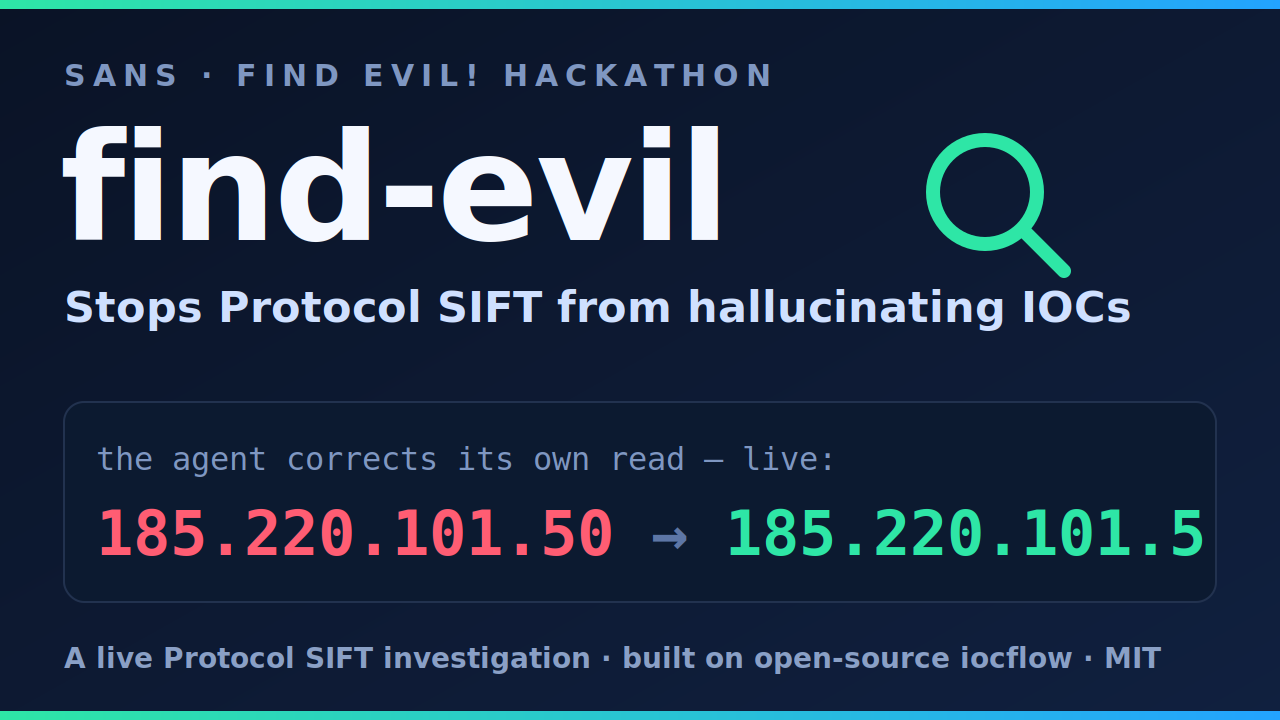
A live Protocol SIFT investigation: the agent extracts, reconciles against ground truth, corrects its own read, and hunts — on the real SANS compromised image.
Why a forensic agent hallucinates 🧠
I’ve spent years building an AI SOC, and I know exactly why this happens. The agent runs a forensic tool, gets back a 50,000-line text dump, and then eyeballs it to pull out indicators. That’s where reality breaks:
- a defanged
evil[.]rugets read back as.com, - an IP’s last octet gets transposed (
185.220.101.50for185.220.101.5), powershell.exegets called “the malware” when it’s a LOLBin.
Free-text reading of enormous dumps is precisely the task LLMs are worst at. And in DFIR a wrong indicator isn’t a typo — it’s a wrong containment decision at 3 AM. So I didn’t try to make the agent “read more carefully.” I took the reading away from it.
The fix: hand the reading to a deterministic parser 🧱
1
2
3
4
5
6
7
8
9
10
SIFT forensic tool (plaso / Volatility / YARA / Sleuth Kit)
        │  raw text dump
        ▼
Protocol SIFT agent (Claude Code)   ── calls instead of eyeballing ──┐
        ▲                                                            ▼
        │  structured, re-fanged, PSL-validated IOCs   iocflow MCP server
        └────────────────────────────────────────────────────────────┘
        │  reconcile eyeballed findings vs extractor ground truth
        ▼
correct values · flag hallucinations · add misses → report + hunts + dry-run blocks
Protocol SIFT, it turns out, isn’t an MCP framework — it is Claude Code configured on the SIFT box (~/.claude/CLAUDE.md, a permissions settings.json, and five skills/*/SKILL.md). That’s a gift, because Claude Code natively loads MCP servers and skills. So the integration is small and first-class, not a hack — two supported patterns at once: Direct Agent Extension and Custom MCP Server.
flowchart LR
  TOOLS["SIFT forensic tools<br/>plaso · Volatility · YARA · Sleuth Kit"]
  AGENT["Protocol SIFT<br/>= Claude Code agent<br/>baseline: eyeballs dumps → hallucinates<br/>find-evil: calls MCP, then reconciles"]
  subgraph MCP["iocflow MCP server (typed, stdio) — ARCHITECTURAL boundary"]
    M1["extract_iocs — re-fang · PSL · dedup · LOLBin-aware"]
    M4["suggest_hunts — CQL · XQL · Sigma"]
    M5["propose_blocks — DRY-RUN only, no execute path"]
  end
  RECON["Self-correction:<br/>reconcile eyeballed vs ground truth<br/>correct · flag hallucinations · add misses"]
  OUT["Reconciled report + hunts + dry-run block plan"]
  TOOLS --> AGENT
  AGENT -- raw text --> MCP
  MCP -- structured IOCs --> AGENT
  AGENT --> RECON --> OUT
  classDef arch fill:#eafaf1,stroke:#00A651,stroke-width:2px;
  class MCP arch
The security boundary is architectural, not prompt-based. The MCP server exposes no execute_shell; propose_blocks is dry-run by construction and the block-execution path is deliberately not a tool. The agent can’t spoliate evidence or push a block because those verbs don’t exist — that turns “please be careful” (bypassable) into “you physically cannot.”
The money-shot self-correction ⟲
I ran it for real against the SANS Example Compromised System Data — a clean host and a compromised one, memory + disk, read-only, SHA256-hashed before and after (unchanged).
On base-wkstn-05, the agent found a 2018 APT scenario: a WmiPrvSE → powershell → rundll32 chain, a fileless PowerShell Empire gzip-base64 stager, and lateral movement under a stolen SQL service account. But the best moment was a correction:
netscanshowed only internal peers — a proxy at172.16.4.10:8080. The eyeball read was “no external C2 — contained.” Wrong. The real C2 (www.venetodns.trade) egresses through the proxy, so it never appears as a foreign IP in the connection table. The extractor surfaced it from the PowerShell command text instead, and the agent corrected itself: there IS external C2; the connection table alone misled me.
Genuine, not staged. And it cut the other way too — false-positive discipline: 15 suspicious external domains were in strings, but only one is tied to the intrusion. The other 14 are Outlook mail-spam. The agent reported 1 confirmed C2, 14 unverified — not a “15 malicious domains” headline. cluster_actor_infrastructure returned 0 campaigns rather than fabricate attribution, and propose_blocks stayed dry_run: true.
Honesty cuts both ways 🧼
On the clean base-wkstn-01, four scary-looking artifacts each got cleared with a tool, not waved away: malfind empty (refutes injection), subject_srv.exe = an F-Response IR agent, and Mnemosyne.sys = F-Response’s signed acquisition driver, not a rootkit. Zero confirmed evil, zero retained hallucinations.
That’s the property I care about most: it found evil where it existed and refused to invent it where it didn’t. Every finding traces back to a specific mcp__iocflow__* tool call in the execution log — which, in a hackathon judged on “honesty over perfection,” is the whole game.
What I took away 📚
The strongest guardrail isn’t a better prompt — it’s an architecture where the dangerous action doesn’t exist as a tool, and the strongest anti-hallucination move is the same shape: don’t ask the LLM to read more carefully, hand the reading to a deterministic parser and make the LLM reconcile. The agent’s job becomes judgment over provenance, not transcription of a 50,000-line dump.
It’s MIT-licensed and bolts onto any Protocol SIFT box in one script:
- Repo: github.com/vinayvobbili/find-evil
- Built on:
iocflow(the IOC lifecycle) anddomainflow(the campaign-clustering pivot) - Demo: the live investigation above
1
2
3
# on the SIFT Workstation, after protocol-sift's own installer
curl -fsSL https://raw.githubusercontent.com/vinayvobbili/find-evil/main/install.sh | bash
claude mcp list   # expect: iocflow
Next up: expose iocflow’s ATT&CK coverage-gap check as an MCP tool so the agent also answers “can we even detect this?” inline, and publish a reconciliation benchmark — hallucination-rate with and without find-evil over labeled cases — as a community baseline. 🚀