attestq: When "We Don't Have Evidence for That" Is the Feature
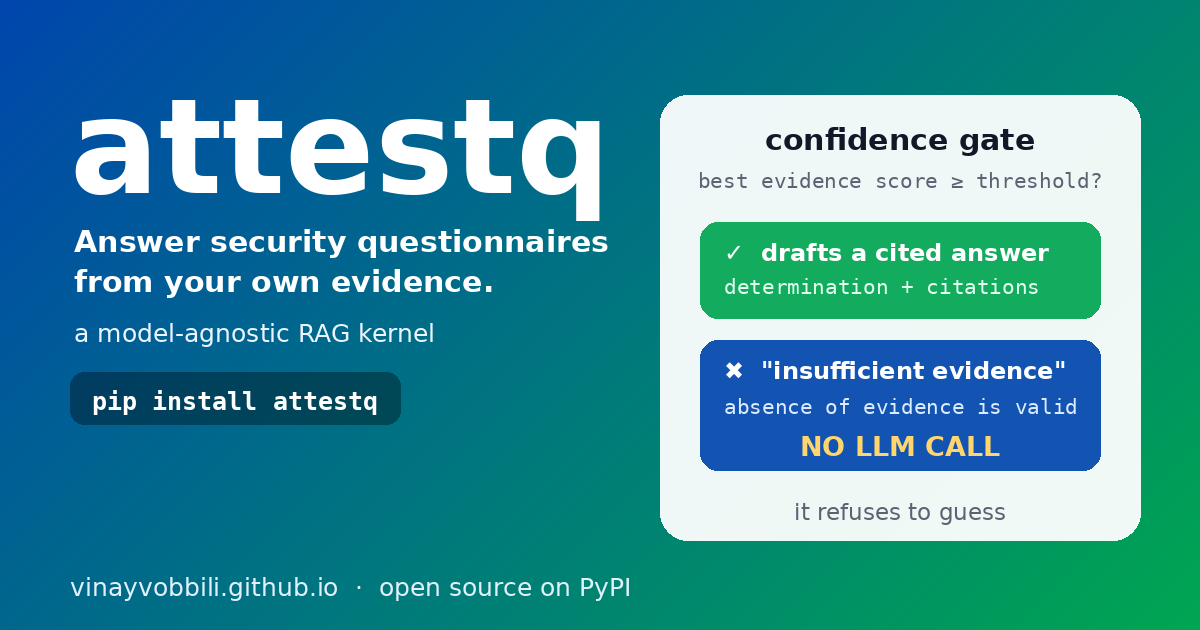
Every security and GRC team rebuilds the same pipeline one-off: chunk the SOC 2s and policies, embed them, retrieve per question, prompt an LLM, paste into the form. Done naively it hallucinates confident answers with no supporting evidence — the single worst failure mode in compliance. attestq is the small, model-/embedder-/store-agnostic kernel I extracted from two production tools (a vendor due-diligence assistant and a customer-assurance drafter) that bakes in the two fixes that actually matter: a confidence gate that answers "insufficient evidence" without ever calling the LLM, and a wide rerank window so the one document that had the answer doesn't get dropped. pip install attestq.
TL;DR 🚀
I shipped attestq to PyPI — a small, model-agnostic RAG kernel for a problem every security and GRC program has: you hold a questionnaire (a vendor security review, a SIG/CAIQ response, an audit-evidence request, a due-diligence form, the security section of an RFP) and a pile of evidence (SOC 2 reports, policies, standards, prior questionnaires). attestq retrieves the relevant evidence per question and drafts a grounded, cited answer — and, crucially, tells you plainly when the evidence isn’t there instead of inventing one. 🧾
▶ Open the interactive version → — a full-bleed page where you can drag the retrieval score across the confidence threshold and watch the kernel flip between a cited answer and “insufficient evidence.”
This is the GRC sibling of my earlier OSS work — iocflow for the IOC lifecycle and detflow for detection engineering. Same instinct: a pattern kept getting hand-rolled inside production tools, so I pulled the durable part out, made it boring and testable, and put it on PyPI. 🧰
The failure mode nobody talks about
If you’ve ever automated questionnaire answering with an LLM, you know the naive recipe: chunk the docs, embed them, retrieve per question, prompt the model, paste into the form. It demos beautifully. Then it does this:
Q: Do you encrypt customer data at rest with a customer-managed key? A (the LLM): Yes. Customer data at rest is encrypted using AES-256 with customer-managed keys rotated every 90 days.
…except none of your evidence says that. The corpus had encryption-at-rest, the model pattern-matched the shape of a good answer, and it filled in the customer-managed-key and 90-day-rotation details from its training prior. In a vendor security review or an audit response, a confident wrong answer is worse than no answer — it’s the thing that gets walked back in front of an auditor.
The fix isn’t a better prompt. It’s accepting that absence of evidence is a valid, first-class result, and building the pipeline so the model never gets the chance to paper over it.
The two fixes attestq bakes in
1. A confidence gate that runs before the LLM
attestq retrieves first, scores the best-matching evidence, and if that score is below min_confidence, it returns an “insufficient evidence” answer without ever calling the model. No prompt, no token spend, no opportunity to hallucinate. The determination you get back is your configured “absence” outcome (e.g. Not Met), with a standardized note explaining the evidence wasn’t found.
flowchart LR
    Q([question]) --> EMB[embed question]
    EMB --> RET[retrieve top-k<br/>from evidence store]
    RET --> GATE{best score above<br/>min_confidence?}
    GATE -->|no| INS[insufficient evidence<br/>NO LLM call]
    GATE -->|yes| RR[rerank<br/>wide window]
    RR --> LLM[LLM drafts a<br/>cited answer]
    LLM --> ANS([determination +<br/>citations + confidence])
The gate keys on the retrieval score — the raw cosine similarity from your embedder, before reranking — so the threshold stays calibrated to a stable scale no matter what reranker you bolt on. (A cross-encoder reorders relevance; it doesn’t produce a comparable absolute confidence. Gating on the retrieval score keeps your one tuned number, min_confidence, meaningful.)
2. A wide rerank window so the right doc survives
The other naive-RAG bug is subtler: you retrieve a handful of chunks, rerank, keep the top 3 — and on a small or lopsided corpus, the single focused document that actually answered the question gets shoved out of the window by a cluster of vaguely-related ones. attestq keeps a deliberately generous post-rerank window (rerank_top_k) so a lone relevant chunk isn’t dropped. This was a real bug in the production tool before extraction; it’s now a default.
Bring your own everything
attestq owns the orchestration — retrieve, gate, rerank, draft, cite. It owns nothing about which model, embedder, or vector store you use. You inject those as plain callables and protocols, so the core has zero third-party dependencies and the package never drags in a stack you didn’t ask for.
1
2
3
4
5
6
7
8
9
10
11
12
13
14
15
16
17
18
19
20
21
22
23
24
25
26
27
28
29
30
31
32
33
34
from attestq import Engine, Question

# Bring your own model + embedder — one-liners around any provider.
def my_chat(prompt: str) -> str:
    ...   # OpenAI, Anthropic, a local model, your corporate gateway, anything

def my_embed(texts):
    ...   # return one vector per text

engine = Engine(chat=my_chat, embed=my_embed)   # in-memory store by default

# Ingest a vendor's evidence into its own namespace.
engine.ingest(
    [
        ("All customer data at rest is encrypted with AES-256.", {"source": "DataProtection.pdf"}),
        ("MFA is enforced for all privileged access.",          {"source": "AccessControl.docx"}),
    ],
    namespace="helios",
)

ans = engine.evaluate(
    Question(
        id="ENC-1",
        prompt="Is customer data encrypted at rest?",
        choices=["Met", "Not Met", "Not Applicable"],
    ),
    namespace="helios",
)

print(ans.determination)          # "Met"
print(ans.confidence)             # 0.0 - 1.0 retrieval confidence
print(ans.insufficient_evidence)  # False
for c in ans.citations:
    print(c.source, "->", c.snippet)
Heavier capabilities ride on opt-in extras, each lazily imported so a missing one fails with a friendly “pip install attestq[x]” rather than an import error halfway through a run:
attestq[chroma]— a persistent Chroma vector store over an existing collectionattestq[openai]— an OpenAI-compatible chat + embedding adapter (anybase_url)attestq[ollama]— local Ollama embeddings and chat, nothing leaves the hostattestq[rerank]— a cross-encoder reranker (score-normalized so the gate stays valid)attestq[loaders]— pdf / docx / xlsx → ingestible chunksattestq[all]— everything
The namespace argument is the GRC-specific bit: vendor questionnaires need per-vendor evidence isolation, not one shared corpus. Each vendor’s docs live under their own namespace, and retrieval filters on it — so Acme’s SOC 2 can never bleed into Helios’s answers.
Try it in ten seconds, no model required
A built-in HashEmbedder needs no model and no service, so you can watch the retrieval pipeline and the confidence gate work the instant you install — then swap in a real provider when you’re ready.
1
2
pip install attestq
attestq demo -o report.md          # runs a bundled fictional sample end-to-end
Point it at your own questionnaire and evidence folder, with any provider resolved from flags or environment:
1
2
attestq run -q questionnaire.yaml -e ./vendor-evidence -n acme -o report.docx
attestq demo --provider ollama     # local, no key, nothing leaves the host
Where it came from (and why I trust it)
attestq isn’t a greenfield toy. It’s the distilled kernel of two tools I built and run in production:
- a third-party / vendor cyber due-diligence assistant that drafts a due-diligence form from a vendor’s uploaded evidence, per-vendor, and
- a customer-assurance drafter that answers inbound customer security questionnaires from our internal policy corpus.
Both were independently solving the same retrieve → rerank → gate → cited-draft problem, and quietly drifting apart. Extracting the shared kernel — and then refactoring the production tool to consume the public package instead of its own copy — means the open-source version is the one under real load, not a sanitized fork. The dogfooding is the point: the same code that ships to PyPI is the code answering real questionnaires.
If you’ve read my three phases of RAG quality post, attestq is what the “grounding” phase looks like when you take it seriously enough to let the system say no.
Why build it this way
The honest lesson across iocflow, detflow, and now attestq is the same: the valuable, durable part of an AI system is usually the boring scaffolding around the model, not the model call itself. Here that scaffolding is one decision — don’t let the LLM answer a question your evidence can’t support — turned into a default you can’t forget to apply.
pip install attestq, bring your own model, and let it tell you when you don’t have the evidence. 🔍
- PyPI: pypi.org/project/attestq
- Source: github.com/vinayvobbili/attestq