Why Self-Hosted Claude Code Was 15× Slower Than It Should Be
A debugging story about a rotating billing header that quietly busted the prefix-KV cache, plus a SimpleEngine patch to actually carry KV state across turns. Two fixes together turned 108-second turns into 7-second turns.
Update (2026-05-14). The SimpleEngine prefix-cache patch described in Finding #2 is now upstream as vllm-mlx PR #523, merged. If you’re on a recent vllm-mlx build, the fix is already there — no local patching required. The walk-through below is still useful for understanding what the patch does and why it was needed.
Update (2026-05-18) — two more sharp edges if you’re running this for real:
Don’t use strict
json_schemaresponse_format against sparse-MoE Coder models. If you also run LangChain (or any OpenAI-compatible client) with structured outputs against the same vllm-mlx instance, preferwith_structured_output(schema, method="json_mode")over the LangChain default"json_schema". The strict path triggers grammar-constrained decoding which has hung on Qwen3-Coder-30B-A3B for 5+ minutes per call — and a wedged decoder starves every queued request, including your Claude Code session, until the server restarts. Filed upstream as vllm-mlx#546.PR #523 fixes the single-slot system-KV cache. You probably also want a multi-slot variant. Claude Code sub-agents (Explore, Plan, general-purpose) carry different tool sets, so each one’s system prefix differs from the main agent’s. With a single-slot snapshot, every sub-agent dispatch evicts the main agent’s cache and vice versa, and you pay the full ~28K-token cold prefill every turn. The multi-slot LRU follow-up is local for now — upstream PR pending.
TL;DR
I run Claude Code against a self-hosted vllm-mlx backend on a Mac Studio. Cold turns took ~108 seconds. Follow-ups took almost the same, even though the system prompt was byte-stable and any LLM engine worth its salt should be caching the prefix.
Two findings, both required to get the speedup:
- Claude Code injects a rotating
x-anthropic-billing-headervalue into the system block on every turn. Even though the user-visible system prompt doesn’t change, the bytes the engine hashes for cache lookup do change every request. The prefix cache misses 100% of the time. Strip the header at the proxy layer and the cache becomes useful. - vllm-mlx’s
SimpleEnginedoesn’t carry KV state across requests. Even with the rotating header gone, you have to patch SimpleEngine to actually cache the system prefix between turns — a small single-slot, hash-keyed cache that restores the snapshot on a hit and prefills only the suffix.
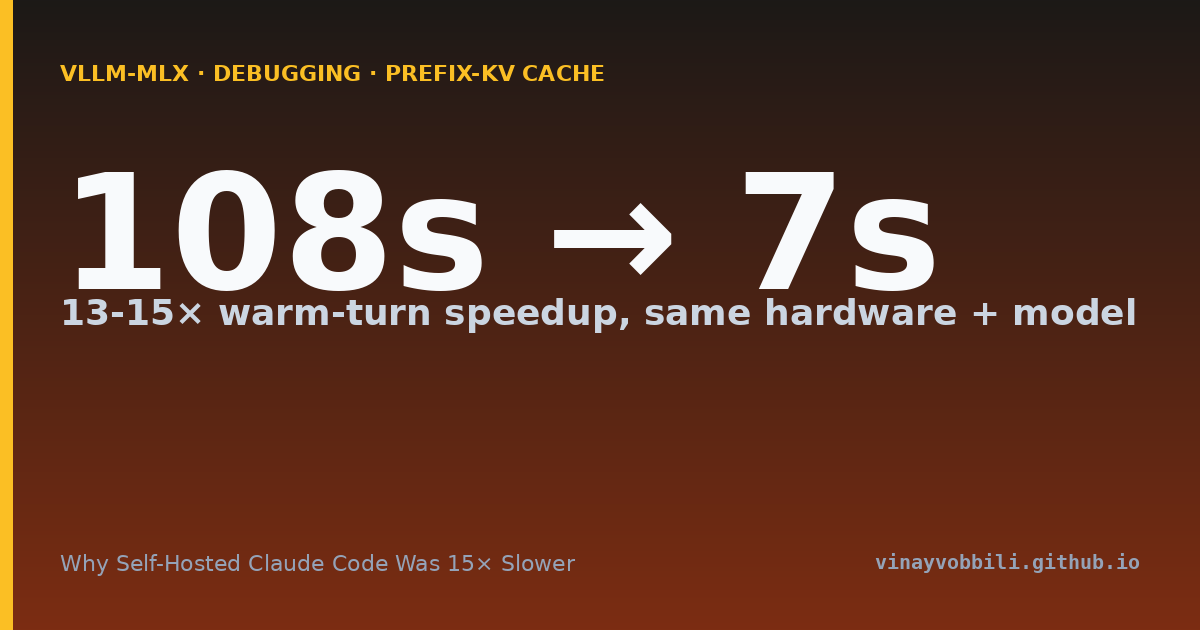
Together: 108-second turns → 7-8 second follow-ups. A 13-15× speedup, on the same hardware, with the same model.
The setup
flowchart LR
    CC[Claude Code CLI] -->|/v1/messages<br/>system + tools + msgs<br/>+ rotating cch=...| CCR[claude-code-router]
    CCR --> Shim["Shim<br/><b>(1) strips x-anthropic-billing-header</b><br/>(2) buffers tool-call streams"]
    Shim -->|byte-stable<br/>system prefix| VLLM[vllm-mlx server]
    VLLM --> SE["SimpleEngine<br/><b>(3) system-prefix KV cache</b><br/>HIT: skip prefill<br/>MISS: prefill + snapshot"]
    SE -->|stream tokens| CC
    style Shim fill:#1e40af,color:#fff
    style SE fill:#7c2d12,color:#fff
The three numbered points are where the speedup comes from. Strip (1) and (3) and you’re back to 100+ second turns.
- Backend: vllm-mlx serving
Qwen2.5-Coder-32B-Instruct-8biton a Mac Studio (96 GB). - Front door: a small FastAPI shim that exposes Anthropic’s
/v1/messagesAPI and proxies to vllm-mlx. - Routing:
claude-code-routertranslates Claude Code’s outbound calls to the shim’s URL with a bearer token. - Client: Claude Code, the CLI.
End-to-end the architecture worked. Tool calling worked. Streaming worked. Output quality was fine. It was just slow — and slow in a way that didn’t match how any of this is supposed to behave.
For context: Claude Code’s prompts are large. Measured across captured requests on this setup, the cacheable prefix — Claude Code’s system instructions plus the tool-definitions block — runs around 23,000 tokens (≈5.6K system + ≈17.6K tools, for a 23-tool toolset). With a working prefix cache, only the new user message and the conversation tail need to be processed each turn — typically a few hundred tokens. Without one, the engine re-prefills ~23K tokens every. single. turn. On a 32K-context model, that leaves about 9K headroom for the conversation and output, which is fine — but only if you’re not throwing away the prefix work each turn.
What I expected vs what I observed
| Cold turn | Warm turn | |
|---|---|---|
| Stock vllm-mlx, no shim | 108 s | ~100 s |
| Shim strips billing header only | 105 s | ~70 s |
| Shim strips header + SimpleEngine KV-cache patch | 108 s | 7-8 s |
The cold-turn number doesn’t change — there’s no cache to hit on the first request. The warm-turn delta is the whole story.
Finding #1: the rotating billing header
The first useful diagnostic was diffing the raw bytes of two consecutive /v1/messages requests from Claude Code. Almost everything was identical: system prompt, tool definitions, conversation history, sampling params. But there was one block in the system list that changed every turn:
1
2
{"type": "text",
 "text": "x-anthropic-billing-header: cc_version=...; cc_entrypoint=cli; cch=<rotating-hash>"}
Claude Code injects this. The cch= value rotates per request — Anthropic uses it for billing and conversation tracking. On Anthropic’s hosted API, the cache layer normalizes around it and there’s no impact. On a self-hosted backend that simply hashes the prompt as-is, the rotating value invalidates the cache key on every request. Every turn looks brand new to the engine, because every turn is brand new.
The fix at the shim is a one-function filter:
1
2
3
4
5
6
7
8
9
10
11
12
13
14
15
16
17
18
19
20
21
22
23
def _strip_billing_header(payload: dict) -> None:
    """Drop Claude Code's `x-anthropic-billing-header` system block.

    Claude Code injects a small system block of the form
    `x-anthropic-billing-header: cc_version=...; cc_entrypoint=cli; cch=<hash>`
    whose `cch` value rotates every turn. Anthropic's cloud uses it for billing
    tracking; local upstreams just see it as 81 bytes of system text. With our
    SimpleEngine prefix-KV cache, that rotating field changes the system-prefix
    hash each turn → every turn is a cache miss → 100s+ prefill on the
    ~23K-token system+tools prefix. Removing this block makes the system
    prefix byte-stable turn-over-turn so the cache actually hits.
    """
    system = payload.get("system")
    if not isinstance(system, list):
        return
    payload["system"] = [
        b for b in system
        if not (
            isinstance(b, dict)
            and isinstance(b.get("text"), str)
            and b["text"].lstrip().lower().startswith("x-anthropic-billing-header")
        )
    ]
81 bytes of rotating text was costing 100+ seconds per turn. Not a great trade.
Note. vllm-mlx PR #277 quietly does the same fix for the
/v1/messagesendpoint. If you’re on a recent build of vllm-mlx and using its native Anthropic adapter, you may already be covered. I run my own shim (for tool-call buffering on the Coder alias — vllm-mlx’s Hermes parser streams tool JSON as content deltas, which doesn’t round-trip cleanly to clients), so I had to strip the header myself.
After this fix, warm turns dropped from ~100 s to ~70 s. A real win, but the prefix cache should have been saving 95+ seconds, not 30. So either the cache wasn’t engaging at all, or it was engaging only partially. Onward.
Finding #2: SimpleEngine wasn’t actually caching the prefix
vllm-mlx ships two engines — both MLX-native, neither is upstream vLLM’s PagedAttention/CUDA core (which doesn’t run on Apple Silicon at all). engine/simple.py is “Simple engine for maximum single-user throughput. Wraps mlx-lm directly with zero overhead for optimal performance when serving a single user at a time.” engine/batched.py is “Batched engine for continuous batching with multiple concurrent users.” For a single-user Claude Code session, SimpleEngine is the right pick — no scheduler, no batching wait, direct access to mlx-lm’s prompt cache. BatchedEngine wins when multiple users hit the same backend concurrently.
SimpleEngine was what I was using. Profiling showed prefill running across the full system + tool prefix on every turn, even after the billing header was gone. The cache hit rate was effectively zero.
The reason: SimpleEngine’s request handler doesn’t carry KV state from the previous request to the next. Each request gets a fresh prompt cache via make_prompt_cache(model) and prefills the whole prompt from scratch. There’s no across-requests cache to hit — the prefix cache lives only inside a single request.
The fix was a small patch: add a single-slot, hash-keyed system-prefix KV cache to SimpleEngine. Detect the system prefix using the ChatML markers that delimit it, hash the prefix tokens, and:
- On a hit, restore the saved KV snapshot and prefill only the suffix.
- On a miss, prefill the system prefix in chunks, snapshot the resulting KV state, and store it (overwriting the previous slot).
1
2
3
4
5
6
7
8
9
10
11
12
13
14
15
16
17
18
19
20
21
22
23
24
25
26
27
28
29
# Excerpt from system_kv_cache_for_simple_engine.patch — a few of the load-bearing lines.

system_hash = hashlib.sha256(system_prefix_text.encode()).hexdigest()[:16]

# ...
if (
    system_hash == self._system_kv_hash
    and self._system_kv_snapshot is not None
    and system_token_count == self._system_kv_token_count
):
    cache_hit = True
    logger.info("System KV cache HIT: reusing %d tokens, prefilling %d new (hash=%s)",
                system_token_count, len(suffix_tokens), system_hash)
else:
    logger.info("System KV cache MISS: will prefill %d system + %d suffix tokens (hash=%s)",
                system_token_count, len(suffix_tokens), system_hash)

# On HIT, restore the saved cache state and skip system prefill:
if cache_hit:
    bc = make_prompt_cache(model)
    for i, saved_state in enumerate(self._system_kv_snapshot):
        bc[i].state = saved_state

# On MISS, prefill the system prefix in chunks, then snapshot:
else:
    # ... chunked prefill of system_tokens ...
    self._system_kv_snapshot = [c.state for c in bc]
    self._system_kv_hash = system_hash
    self._system_kv_token_count = system_token_count
A few design choices that mattered:
- Single slot, not LRU. A Claude Code session has one conversation at a time, so multi-slot is overkill. The slot just stores
(hash, snapshot, token_count)and overwrites on miss. - Hash the prefix only, not the full prompt. That way the cache survives new user messages on the tail end — which is the common case.
- ChatML marker detection. The boundary between system and user is found by searching the rendered prompt for
<|im_start|>user\nor<|im_start|>assistant\n. If neither marker is found, fall back to the uncached path and don’t break. - Safe fallback on any exception. If the cache-aware path fails for any reason, log a warning and fall back to the original
stream_generate. Don’t let a perf optimization take down generation.
The full patch is upstream as vllm-mlx PR #523. Review hardened the original cut: closure-local capture at the gate to close a TOCTOU race against the snapshot pointer, and an init-time probe that disables the cache for sliding-window models whose RotatingKVCache aliases buffers the engine mutates in place. The merged code is the right reference to read if you’re curious about the cache mechanics.
The numbers
After both fixes were in place, warm-turn wall-clock dropped from ~70 s (billing-header fix alone) to 7-8 s (billing-header fix + SimpleEngine KV cache). The cold turn is unchanged — there’s no prior turn to cache against on the first request — but the cache hit rate from turn 2 onward is essentially 100%, and the speedup is large enough that Claude Code becomes interactive instead of glacial.
What I’d do differently
Diff the inputs before profiling the engine. The billing header would have fallen out of a 30-second diff of two consecutive request bodies. I didn’t run that diff for far too long — I was looking at vllm-mlx internals, profiling prefill, reading mlx-lm cache code, anything but the actual bytes going over the wire. Once I finally did the diff, the rotating cch= value was on the screen in five minutes.
That has become a personal rule for any latency mystery on a black-box stack: capture two consecutive requests, diff them, look at what’s not stable before assuming the engine is misbehaving. It would have saved me an evening on this one and I suspect it’ll save me more.
The second thing I’d change: the SimpleEngine cache patch should have come after I’d quantified what the billing-header strip alone bought me. I lumped both fixes in the same session, which made it harder to attribute the speedup cleanly. The numbers in this post are reconstructed from a follow-up measurement; if I’d been disciplined the first time, I’d have had them ready.
When you’d hit this
You’ll hit some version of this if you:
- Self-host an Anthropic-compatible LLM backend (vllm-mlx, llama.cpp’s Anthropic adapter, a custom shim, etc.) and point Claude Code or another Anthropic-protocol client at it.
- Notice that warm turns aren’t faster than cold turns even though your system prompt is byte-stable.
- See the engine’s prefill phase running across the full prompt every turn in profiling.
If you’re using Anthropic’s hosted API, none of this applies — the platform handles the billing header and prefix caching transparently.
Reproducing this
The two pieces that make the speedup happen:
- Billing-header strip — about 15 lines of FastAPI shim code that filter the rotating
x-anthropic-billing-headerblock out of the system list before the payload reaches vllm-mlx. Identical logic to what vllm-mlx PR #277 does natively on the/v1/messagesadapter; you only need a shim if you’re not on that path. - SimpleEngine prefix-cache — now upstream as vllm-mlx PR #523. Read the merged code if you want the cache mechanics; the load-bearing logic is the hash check, the snapshot capture on miss, and the safe fallback when the detection fails.
Credits
vllm-mlx PR #277 found the billing-header issue independently for the /v1/messages endpoint. If you’re using vllm-mlx’s native Anthropic adapter rather than your own shim, that’s the right upstream fix. The SimpleEngine prefix-cache patch landed in vllm-mlx PR #523 — thanks to the maintainers for the review, which improved the patch in two specific ways (closure-local capture against a TOCTOU on the snapshot pointer, and a sliding-window guard for RotatingKVCache).
If you’ve hit this too, or your self-hosted Claude Code setup is slow for a different reason I haven’t found yet, I’d love to hear about it — reach me on LinkedIn or by email.